iBrace 3D Scanning App for Custom Orthotics
Precise Body Scanning to Increase Clinician Productivity
Categories
Healthcare & Medtech | IoT
Technologies used
iPadOS | Occipital Structure Sensor SDK | 3D Mesh Capture
About The Client
iBrace is a Québec-based manufacturer of custom orthopedic devices, distributed through partner clinics. The company describes itself as drawing on 35 years of orthotics knowledge, and states on its own site that it works with more than 100 partner clinics worldwide.
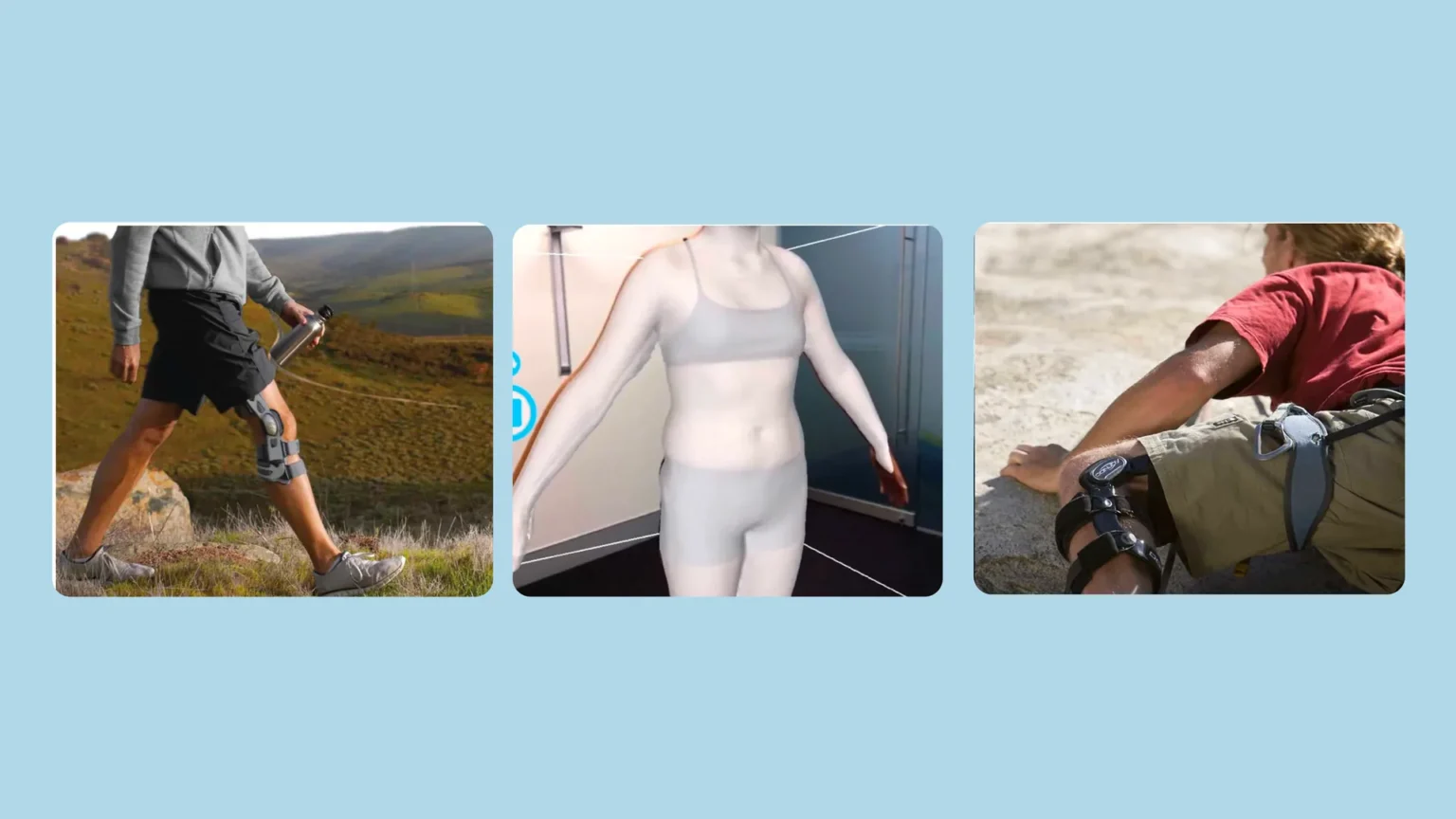
Its product line covers far more than feet. It includes knee orthoses, with an osteoarthritis option, rigid or flexible ankle-foot orthoses, lumbar and thoraco-lumbar back braces available on a 24/7 express service, plantar orthotics, and cranial orthoses for infants, used to treat plagiocephaly. This is what custom orthotics app development looks like at full scale: every one of these devices, across an entire body, ordered by clinicians through a single iPad app.
Project Overview
The Project
Sidekick Interactive started building for iBrace around 2016 and 2017, early days for digital scanning in the orthotics and prosthetics industry. At the time, plaster casting was still the standard intake method. A digital alternative existed, but it meant buying a fixed scanning booth: expensive, immovable, and out of reach for most clinics.
Occipital’s Structure Sensor changed that math. A depth sensor that clips onto an iPad cost a fraction of a booth and fit in a drawer. Nobody had yet proven it could capture a limb accurately enough for a production team to manufacture from, and the SDK behind it was still young. iBrace bet that it could. What Sidekick delivered was a piece of iOS medical app development built specifically around Occipital’s Structure Sensor SDK, running on its own dedicated codebase, the app that settled the question.
The Context
Three requirements shaped the build, and iBrace treated all three as non-negotiable. The app had to beat a scanning booth on cost and accessibility, since a partner clinic needed to start working with an iPad and a clip-on sensor rather than a capital purchase and a room renovation. It had to work in the hands of clinicians, not technicians, meaning nothing about point clouds, mesh density, or sensor calibration could ever surface on screen. And it had to produce files the production team could manufacture from directly. That third point is what made the project hard: a scan that looks fine on a screen but turns out unusable in fabrication costs iBrace a remake, and costs the clinic a patient’s second appointment.
Challenges and Technical Constraints for iBrace's 3D Scanning App
The Challenge
Proving that a consumer-grade depth sensor and a young SDK could capture limbs to production accuracy
Keeping the interface usable by orthotists, podiatrists, and physiotherapists with zero background in 3D scanning
Eliminating the need for a technician to redo any capture by hand before it reached the fabrication floor
Extending capture across an entire body of new orthotic types over the years, without breaking the core workflow clinicians already knew
Constraints
A native iPad build directly on the Structure Sensor SDK, at a point when the SDK itself was still maturing
On-device corrections precise to the degree and the millimetre, applied before a file ever left the clinic
Bilingual distribution, free on the App Store, with unlimited scan export, since the entire partner-clinic model depended on it
Nine years of ongoing compatibility across three generations of Structure Sensor hardware and roughly a dozen major iOS releases, while iBrace’s own product range nearly tripled
Our Approach and Solution for iBrace's 3D Scanning App
Capture Built For Clinicians, Not Technicians
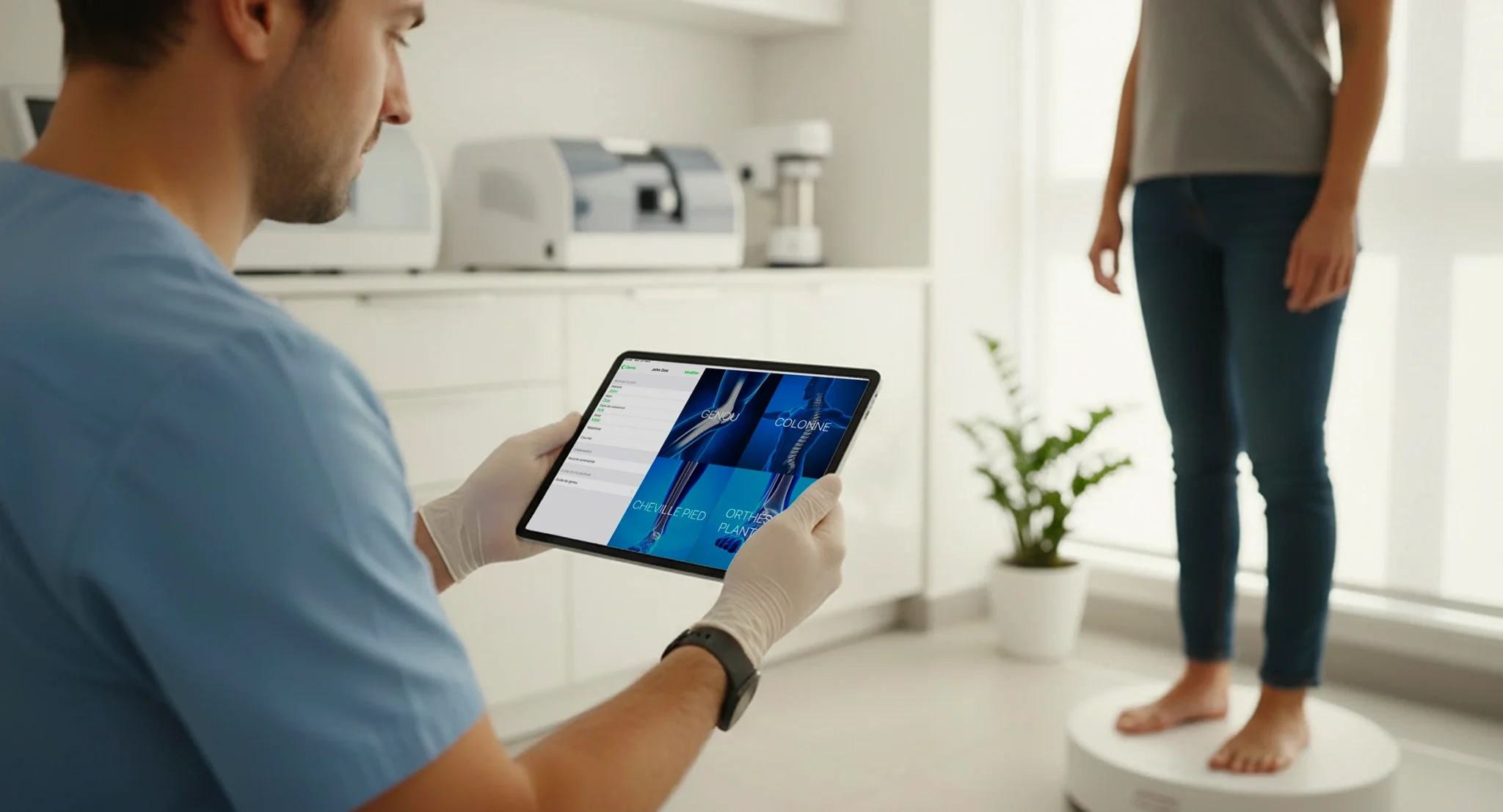
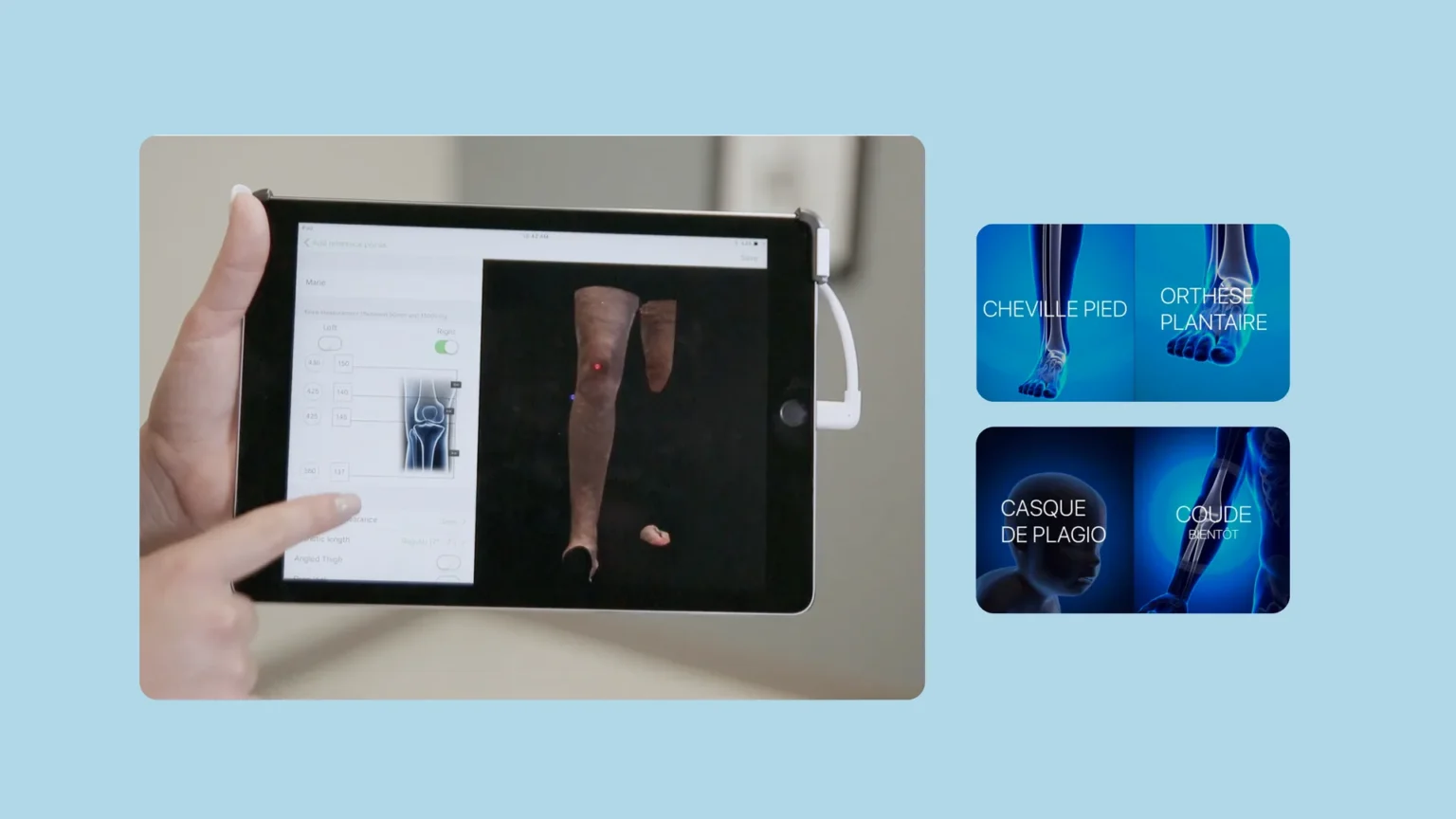
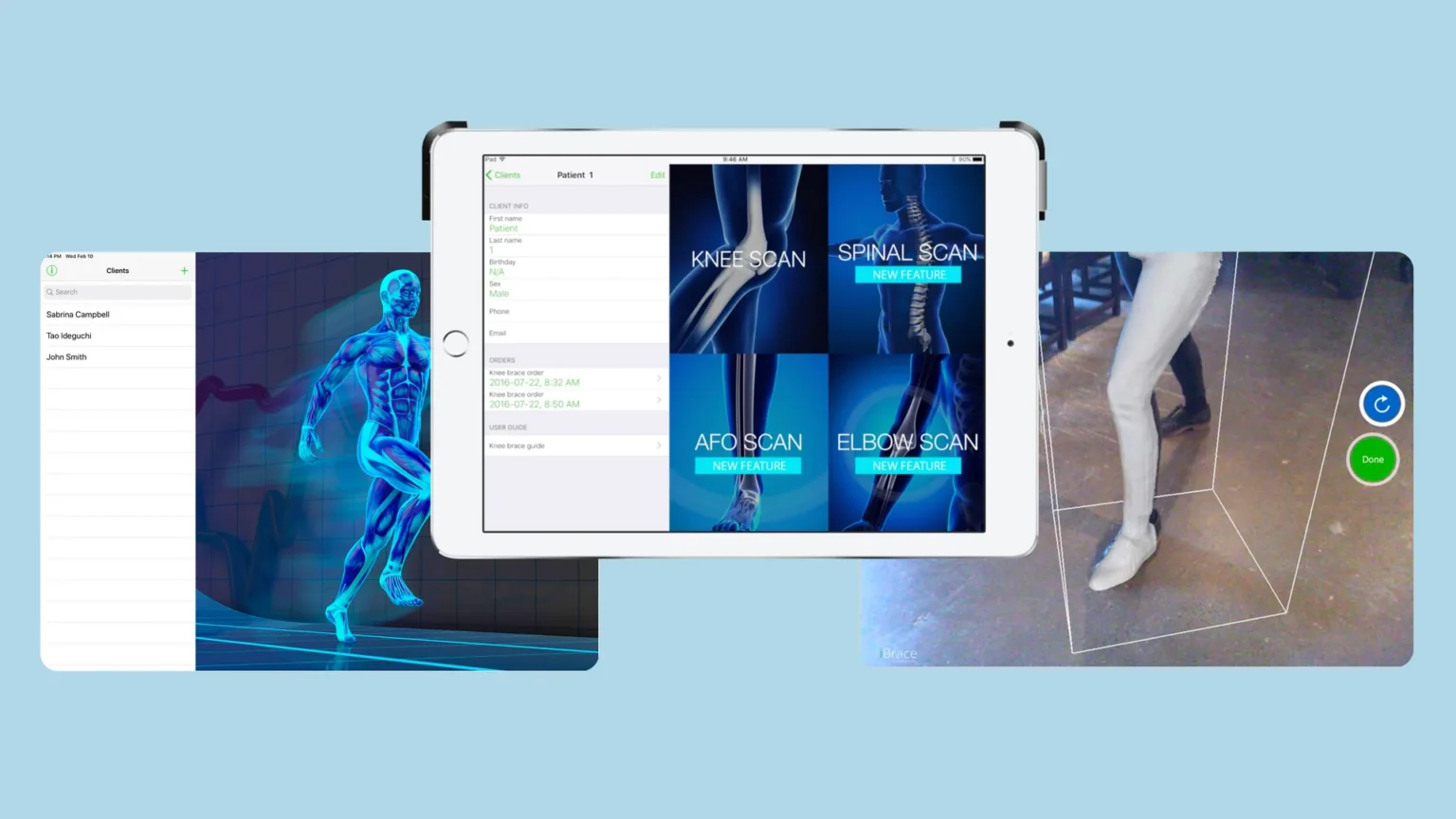
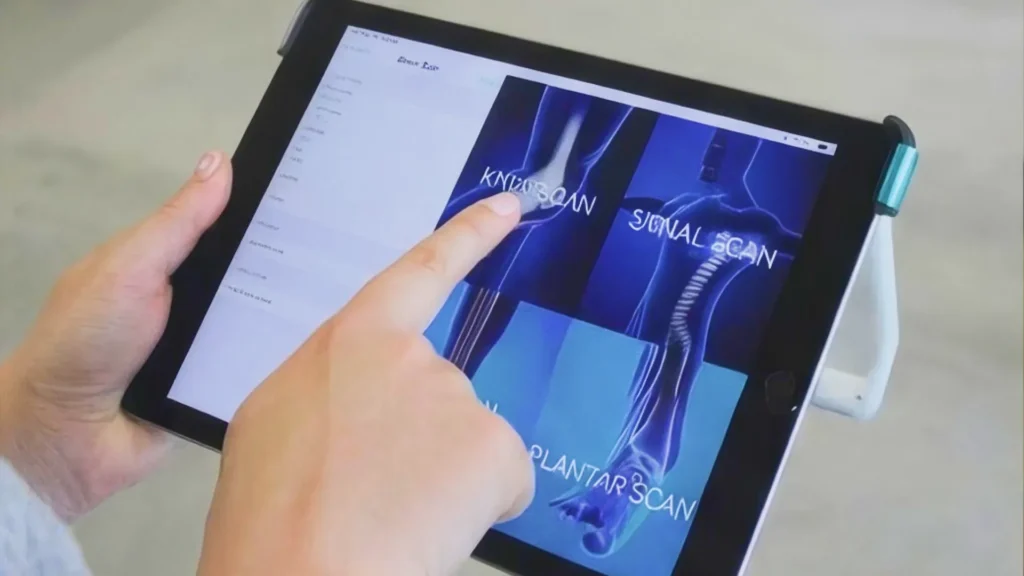
The app lets a clinician scan a body part in a few taps. We built it first for joints, then extended it as iBrace’s range grew: spine, plexus, cranium, tibia, and foot. Every technical detail behind the scan, from mesh density to sensor calibration, stays out of view. The clinician sees a scanning guide and a result, nothing else.
Correction And Production-Ready Output
Clinicians can apply corrections directly on the iPad, to the degree and the millimetre, before anything leaves the room. That single design decision removes an entire category of back-and-forth between the clinic and iBrace’s fabrication team, since the file that leaves the clinic is already the file production will use.
Order And Distribution In One Continuous Flow
From the same screen, the clinician completes the production specification and sends the order straight to iBrace’s central fabrication facility. iBrace publishes the app free on the App Store, in English and French, with unlimited export, so any partner clinic can download it and start working the same day.
Nine Years Of Continuous Evolution
This wasn’t a build-and-walk-away project. Photo attachment per scan and cranial helmet ordering arrived in 2017. Structure Mark II support landed in 2021 when Occipital refreshed its hardware. New brace options and order processing improvements have continued since, with the most recent release shipping in June 2026. Keeping a piece of connected hardware reliable across three sensor generations and a decade of iOS updates sits close to the same discipline Sidekick applies on its IoT and connected-device work, even outside the healthcare space.
Results and Benefits for iBrace's 3D Scanning App
Results
now originates in this app, across every one of iBrace’s own clinics and partner clinics, with no parallel paper or plaster process left in the business
now order through the app, according to iBrace’s own reporting
Live on the App Store since 2017, with nine years of continuous releases spanning three Structure Sensor hardware generations and roughly a dozen major iOS versions
The product range now covers four capture types, joint, plantar, cranial, and tibial, all carried by the same core app that launched with joint capture alone
For a manufacturer whose entire business depends on capture accuracy, routing every single order through one piece of software is about as strong a vote of confidence as a case study can point to.
Why iBrace Chose Sidekick Interactive for its 3D Scanning App
iBrace chose Sidekick Interactive for a working relationship that started in the earliest days of consumer-grade 3D scanning in orthotics and never stopped, backed by nine years of continuous maintenance across three hardware generations and a decade of iOS releases, a track record most agencies simply can’t point to. Beyond the longevity, iBrace valued deep, hands-on experience turning an unproven SDK into a production-grade clinical tool. That expertise was also validated from the outside: HP, whose own market research into the O&P scanning space identified iBrace’s app as one of the best in the field, and it led them straight to Sidekick.
“The challenge for iBrace has been to develop a tablet application that can be adapted with the 3D Structure Sensor SDK scanner. It was necessary to make this tool very powerful and easy to use for health professionals. As of today, this application brings a real gain of productivity thanks to its precision.”
Alexandre Boyer-Laporte, Co-Founder, Sidekick Interactive
Sidekick Interactive's Expertise in 3D Scanning App Development
This project reflects our position in the MedTech space, and more specifically in orthotics and prosthetics. Our team combines native iOS development, Structure Sensor integration, and clinical-grade UX design for applications where technical precision has to disappear behind an interface a clinician can pick up without training. That same logic of connecting hardware and software reliably also drives our work in IoT projects more broadly.